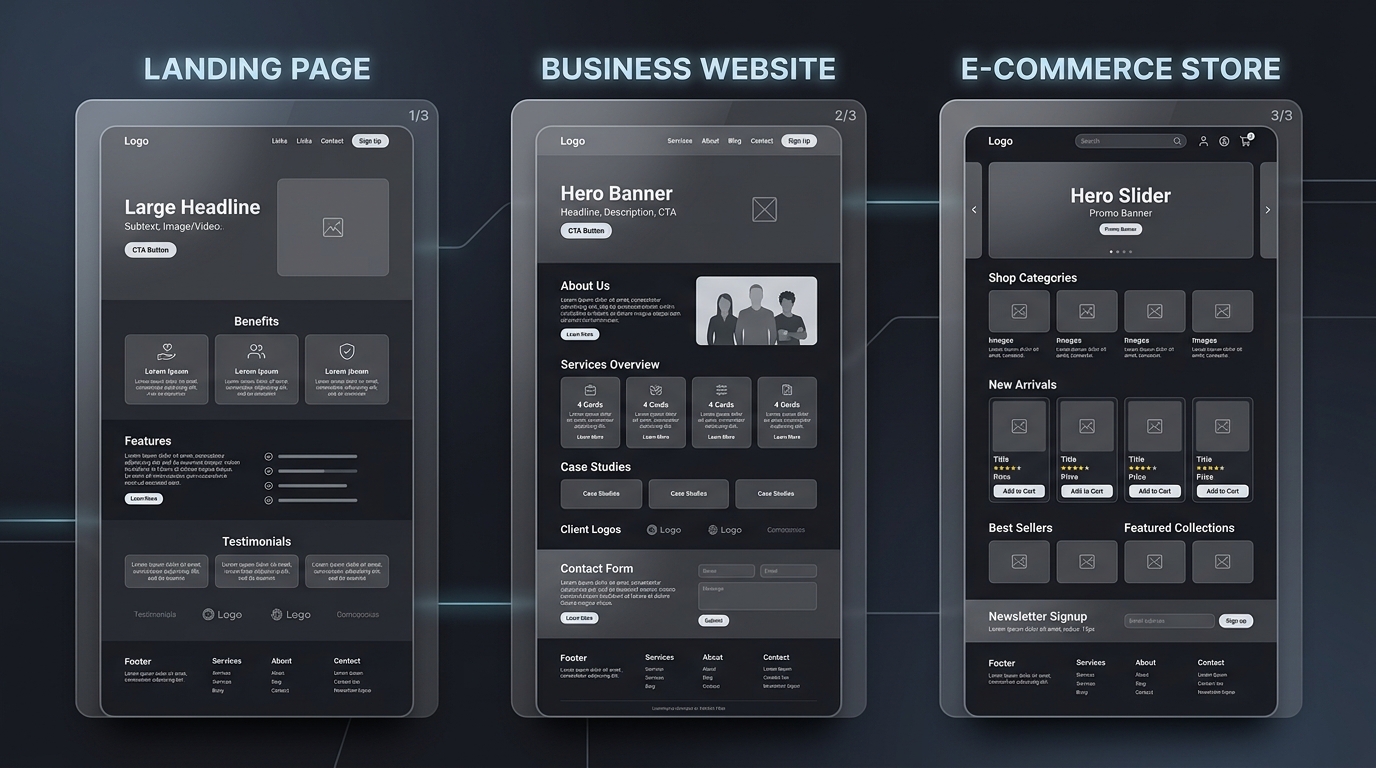
If you've been looking into getting a website built, you've probably come across the term "landing page" and wondered how it's any different from just, well, a website. It's a fair question. On the surface they can look similar. Both have images, text, maybe a contact form. But the way they're built, and more importantly what they're built to do, are two very different things.
Let's break it down in plain terms.
A standard website is there to tell your story
Think of a standard website as your business's home online. It usually has multiple pages: a home page, an about page, a services page, maybe a contact page and a blog. People land on it for all kinds of reasons. Some are just browsing. Some found you through Google. Some are checking if you're a real business before they decide to trust you.
Because of that, a standard website has to do a lot of jobs at once. It needs to explain who you are, what you offer, why you're credible, and give people a way to explore at their own pace. There's no single action it's pushing you toward. It's more like a well organized shop where people can wander in, look around, and leave whenever they want.
This is exactly what you need for things like a company profile, a chamber of commerce site, or a business that mainly wants to build trust and be found. Nobody expects to "convert" the moment they land on an about page, and that's fine.
A CRO landing page has exactly one job
CRO stands for conversion rate optimization, which sounds technical but really just means the page is built with one goal: getting the person who lands on it to take one specific action. That could be sending a WhatsApp message, filling out a form, or booking a call.
Because of that single focus, everything on the page is working toward that one outcome. There's usually no menu bar pulling people away to other pages. The headline speaks directly to the exact problem the visitor is thinking about. The layout guides your eye naturally toward the button you're meant to click. Testimonials or results are placed right where someone might be hesitating, not buried at the bottom where nobody scrolls.
It's less like a shop and more like a really good salesperson who already knows exactly why you walked in and answers your objections before you even ask them.
Why this actually matters for your ad spend
Here's the part most people don't think about until it costs them money. If you're running paid ads and sending that traffic to a normal website, you're asking people who are already in a rush and already skeptical to figure out where to click and what to do next. A lot of them just leave.
We saw this play out clearly with one of our own clients, a boutique villa. Instead of sending ad traffic to a general website, we built a page focused entirely on getting people to book. The villa was fully booked for three months, starting just ten days after the campaign went live. That's not a coincidence. It's what happens when a page has one job and does it well.
So which one do you actually need?
Honestly, most businesses need both, just for different purposes.
You want a standard website if you're building long term trust, want people to learn about your full range of services, or need a proper home base that shows up when someone searches your business name.
You want a CRO landing page if you're running a specific campaign, launching an offer, or spending money on ads and want that traffic to actually turn into real inquiries instead of just visits.
The mistake we see most often is businesses spending on ads and sending that traffic straight to their homepage. It's not that the homepage is bad. It's just doing a different job than the one you need in that moment.
If you're not sure which one fits what you're trying to do, that's a pretty normal place to be, and it's worth a quick conversation before you spend money finding out the hard way.