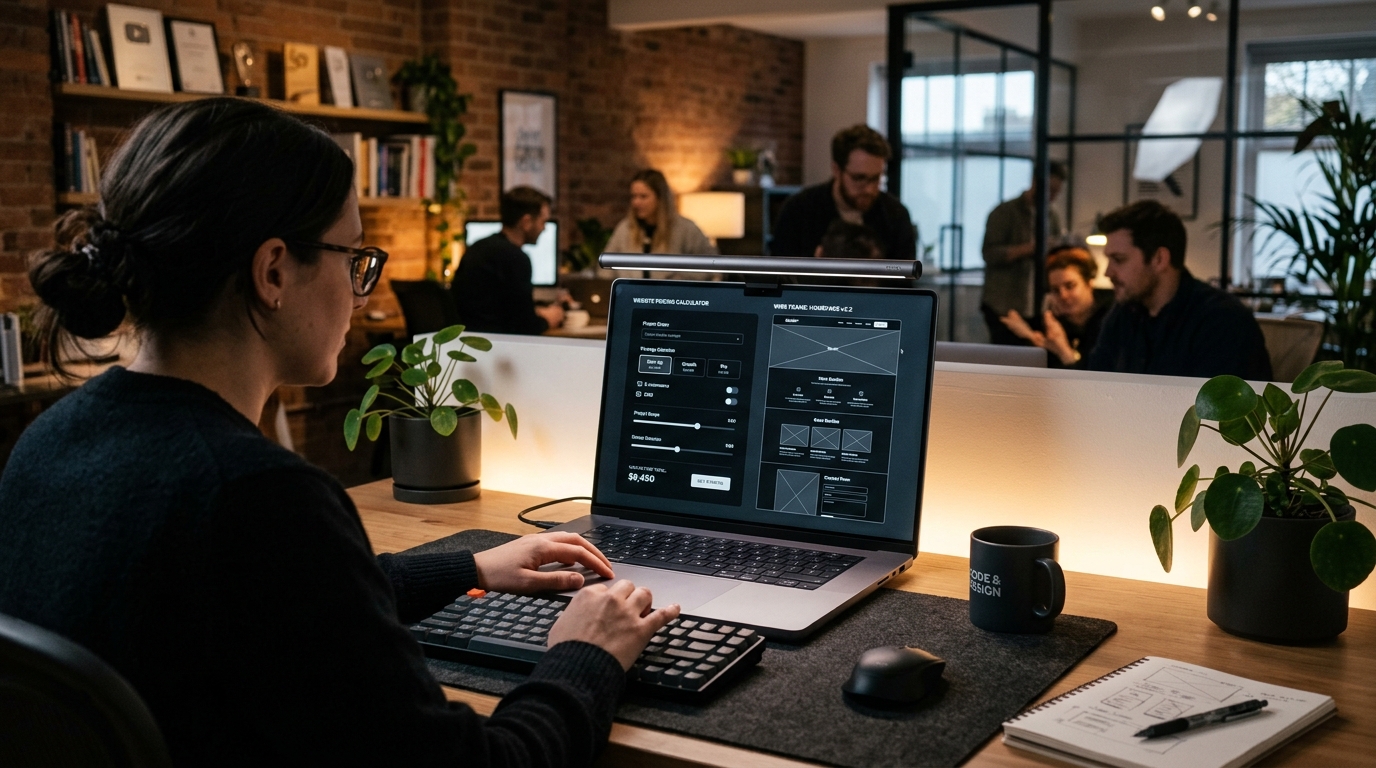
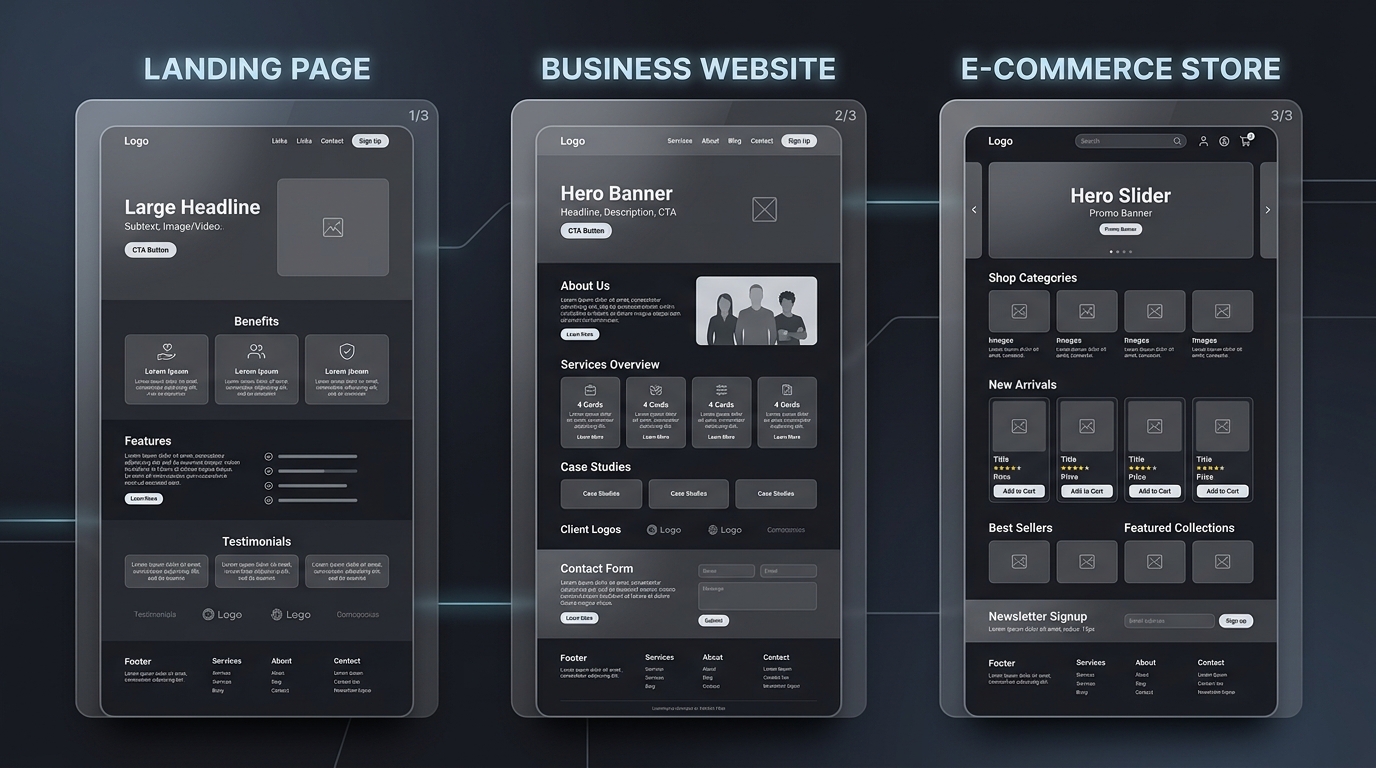
Choose a landing page if you have one specific action you want visitors to take, usually tied to an ad campaign. Choose a multi-page website if you need to be found on search engines and explain several services. Choose an online store if you're taking payment for products. Choose a custom web application if users need to log in and the system needs to do work for them (bookings, dashboards, portals, marketplaces).
Most small businesses need a multi-page website. Many think they need a custom app and don't.
"We need a website."
It's how almost every project starts, and it's a bit like walking into a hardware shop and saying "I need a tool." Perfectly reasonable. Also not enough to go on.
The four options below solve genuinely different problems, cost very different amounts, and take very different lengths of time. Picking the wrong one is expensive in both directions: overbuilding wastes money, while underbuilding fails completely.
The four options at a glance
| Landing page | Business website | Online store | Custom web app | |
|---|---|---|---|---|
| Main job | Convert one specific audience | Be found, explain, generate enquiries | Sell products online | Let users log in and do things |
| Pages | 1 | 5–20 | 20+ | Varies |
| Typical cost (LKR) | 30,000 | 60,000 – 90,000 | 195,000+ | 200,000+ |
| Build time | 1–2 weeks | 3–6 weeks | 6–12 weeks | 3+ months |
| SEO potential | Very limited | Strong | Strong | Usually not the point |
| Ongoing effort | Low | Low–medium | High | High |
| Best paired with | Paid ads | SEO and content | Ads and email marketing | A real business process |
Landing pages
A landing page is one page with one goal and nowhere else to go. No menu full of distractions. No "About Us." Just a headline, a reason to care, some proof, and a button.
They exist because of a specific problem: when you send paid traffic to a homepage, most of it wanders off. A homepage is designed to serve everyone. An ad audience isn't everyone; they clicked on a specific promise, and the page should keep that promise immediately.
Use one when:
- You're running Google or Meta ads and want to stop wasting the click
- You're launching a single product, course, or event
- You want to test demand for a service before building anything bigger
- You need a page for a specific audience segment that your main site doesn't serve well
Skip it when:
- You have no traffic source. A landing page with no ads behind it is a page nobody visits. They rank poorly on their own because one page can only cover one topic.
- You offer six services and want to be found for all of them.
One thing people get wrong: they build one landing page and stop. The businesses getting real value from landing pages usually run several (one per campaign, per audience, or per offer) and compare them against each other.
Business websites
The standard multi-page site. Home, about, services, portfolio or gallery, blog, contact. This is what most businesses actually need, and there's nothing boring about doing it properly. (See our Sri Lanka Website Cost Guide for pricing details).
The reason it beats a landing page for most companies is search. Each page can target a different topic. A physiotherapy clinic with separate pages for sports injuries, back pain, post-surgery rehab, and home visits has four chances to be found. A single page has one.
It's also where trust gets built. People check whether you look real before they call. A proper about page with actual faces, a portfolio with actual work, and a contact page with an actual address does more for conversion than most people credit. Learn more about our Web Design & Development services.
Online stores
The moment you take payment, complexity multiplies.
You're no longer publishing information. You're running a system that handles inventory, prices, variants, shipping rules, taxes, payment processing, order confirmations, refunds, and a customer's expectation that all of it works perfectly at 2am.
Use one when:
- You sell physical or digital products directly
- You want to sell beyond your local area
- You're currently taking orders through WhatsApp or Instagram DMs and it's become unmanageable
Things to decide early, because they change the build significantly:
- How many products, and do they have variants? Twenty t-shirts in five sizes and four colours is 400 combinations to manage.
- Which payment gateway? In Sri Lanka, PayHere and Onepay are common for local cards. Stripe or PayPal for international customers. Cash on delivery is still widely expected locally and needs to be built in properly.
- Are you selling overseas? Multi-currency, international shipping rates, and customs information all add work.
- Who's packing the boxes? Software doesn't solve fulfilment. Plenty of stores launch beautifully and collapse under the operational load.
Honest advice: if you're selling fewer than ten products and just started, a well-built business website with a simple payment link may serve you better than a full store. You can upgrade later. Building a 200-product store for a business that sells six things is a common and expensive mistake.
Custom web applications
Booking systems, client portals, internal dashboards, membership platforms, marketplaces, SaaS products. Anything where users log in and the system does real work on their behalf.
This is a different category of project. You're not making a website, you're making software that happens to run in a browser. It needs specification, database design, security thinking, testing, and ongoing development. It never really "finishes."
Use one when:
- Your business runs on a process that spreadsheets and WhatsApp can no longer hold together
- Customers need to log in to see something personal to them
- You're building a product, not just marketing one
- Off-the-shelf tools genuinely don't fit, and you've properly checked
Before you commit, check the alternatives. A lot of "we need a custom system" conversations end with a much cheaper answer: an existing booking tool, a no-code platform, or a well-configured CRM. Custom development is right when your process is genuinely unusual or is itself your competitive advantage. It's wrong when you just haven't found the existing tool yet. Talk to our team about custom development options.
If you do go custom: insist on a discovery phase before anyone quotes a full build. Two weeks spent properly specifying what you need will save months. Any agency quoting a custom app from a one-paragraph brief is guessing, and you'll pay for the difference between their guess and reality.
A three-question shortcut
1. Do people pay you money on the site itself?
Yes → online store (or a custom app if it's services and scheduling)
No → keep going
2. Do users need to log in to see something personal?
Yes → custom web application
No → keep going
3. Are you trying to be found on Google for multiple things?
Yes → business website
No, I just have ads pointing at one offer → landing page
Nine times out of ten this lands you in the right place.
Can you combine them?
Yes, and most mature setups do.
A typical arrangement: a business website as the main presence, with several campaign landing pages sitting on the same domain for advertising, and a store section if products are involved. A custom app usually lives on a subdomain (app.yourcompany.com), separate from the marketing site.
Keeping them on one domain matters for SEO. Every page contributes to the domain's overall authority, so scattering things across three unconnected domains works against you.
Frequently asked questions
Can a landing page rank on Google?
For one very specific phrase, sometimes. But a single page has limited content and few internal links, which are both ranking factors. Landing pages are built for paid traffic, not organic search.
Should I build a website or just use social media?
Both, but the website is the one you own. Social platforms change their algorithms, restrict reach, and can suspend accounts without warning. A business relying entirely on Instagram is building on land it doesn't hold the deed to.
Is Shopify or WooCommerce better for a Sri Lankan business?
WooCommerce (on WordPress) tends to work better locally: there is no monthly platform fee, easier integration with Sri Lankan payment gateways, and full control over hosting. Shopify is simpler to run and better suited if you're primarily selling internationally and want less technical responsibility.
Can I start small and upgrade later?
Yes, if it's planned for. Tell your developer your likely direction so they choose a platform and structure that can grow. Retrofitting a store onto a site built without it in mind often means rebuilding.
How many pages does a small business website need?
Usually five to ten: home, about, one page per main service, a portfolio or testimonials page, and contact. One page per service matters: a single "Services" page listing everything ranks far worse than individual pages.
What's the difference between a website and a web application?
A website mainly presents information; a web application performs tasks for logged-in users and stores their data. A restaurant's menu page is a website. The system the restaurant uses to manage table reservations is a web application.
Not sure which one you need?
We're Engage Studio, a digital agency in Kandy building landing pages, business websites, online stores, booking platforms, and custom web applications for clients in Sri Lanka and overseas.
Tell us what you're trying to achieve and we'll tell you the smallest thing that will do the job. Get in touch.