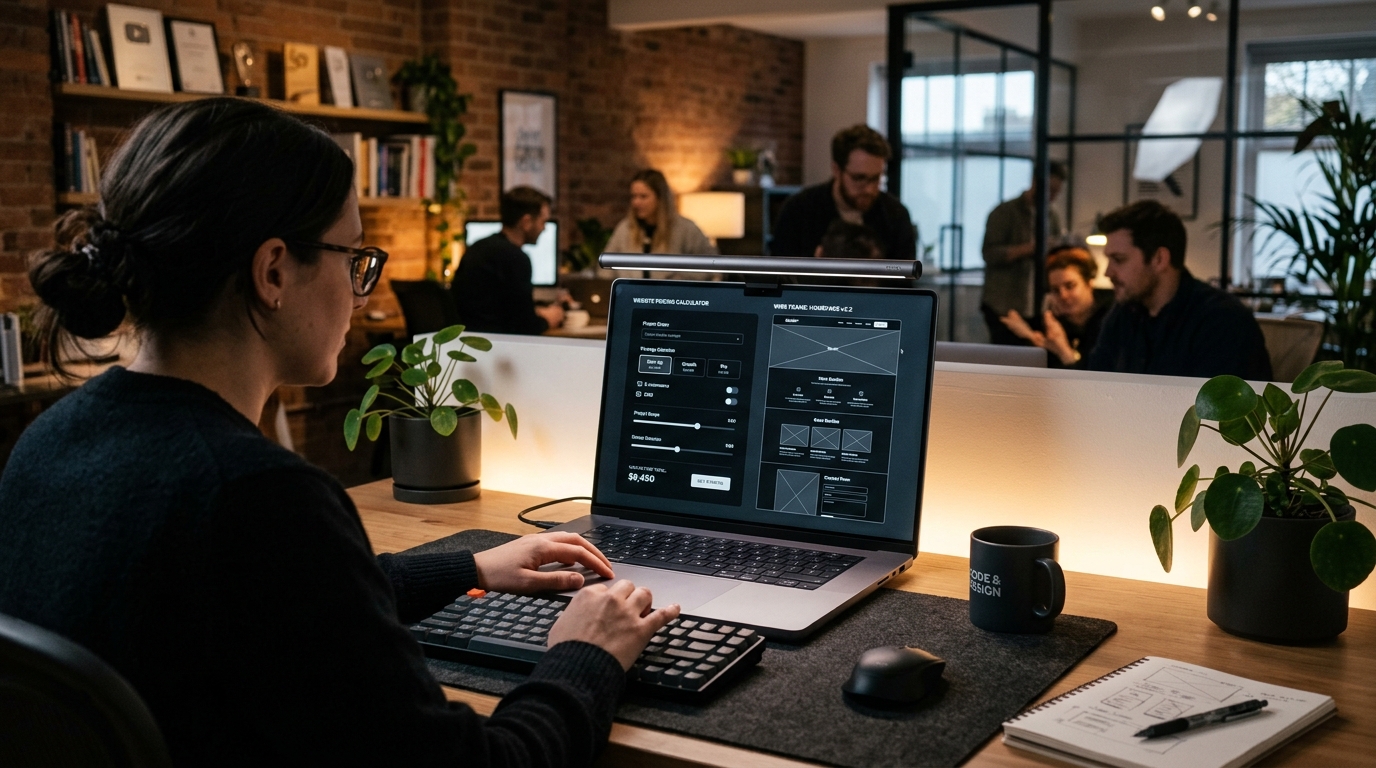
A business website in Sri Lanka typically starts at LKR 30,000 for a one-page site. A 5-page standard business site without a custom CMS costs LKR 60,000, while a 5-page site with a full CMS is LKR 90,000. Ecommerce stores start at LKR 195,000. Booking platforms and custom-developed web applications start at LKR 200,000 and go up depending on technical complexity.
Hosting and maintenance are separate and ongoing, usually LKR 3,000 to LKR 25,000 per month.
(Note: All prices will vary based on current promotions, active discounts, and exact project scope.)Ask three agencies what a website costs and you'll get three wildly different answers. One says LKR 30,000. Another says LKR 600,000. Both are describing something they'd call "a website."
That's not because anyone's lying. It's because "website" describes a category, not a product, much like how "vehicle" covers both a tuk-tuk and a lorry. Both get you down the road. They're built for very different jobs.
So here's a proper breakdown of what you'd actually pay in Sri Lanka right now, what sits inside each price band, and how scope or active promotions affect your final quote.
What you're actually paying for
Before the numbers, it helps to know where the money goes. A website quote is usually about five things:
- Strategy and structure. Someone has to decide what pages exist, what each one says, and where the buttons go. On small projects this takes a couple of hours. On bigger ones it's weeks.
- Design. How it looks, and more importantly, how it feels to use on a phone at 11pm with one bar of signal.
- Development. Turning the design into a working site. This is where custom functionality (such as booking calendars, payment gateways, or member logins) adds time.
- Content. Writing, photography, video. Most quotes assume you're providing this. Most clients assume the agency is. Worth clarifying early.
- Testing and launch. Checking it works across browsers, devices, and connection speeds. Setting up analytics. Pointing the domain.
When one quote is a third of another, it's almost always because two or three of those five have been quietly removed.
Price bands, with what's inside them
(All prices vary based on current promotions, seasonal discounts, and exact client scope.)
One-page website : LKR 30,000
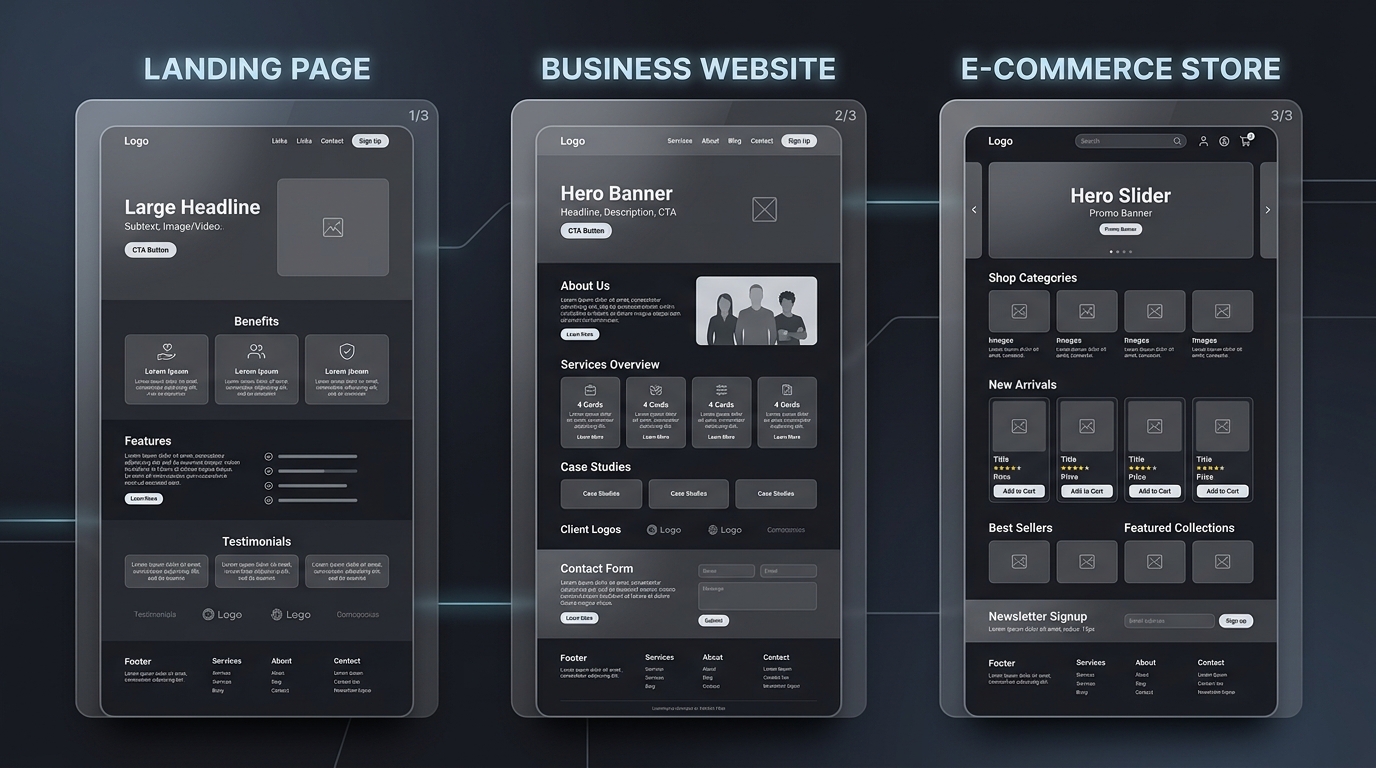
One page. One goal. Built to support an ad campaign, a product launch, or a focused local service. (Read our guide on Landing Page vs Website vs Online Store for more details).
You get a single scrolling page with a clear call to action, a contact or enquiry form, mobile-responsive design, and basic on-page SEO. Turnaround is typically one to two weeks.
Good for: campaign pages, event registration, testing a new service before you commit to a full site, app download pages.
Not good for: businesses that need to be found on Google for a wide range of services. One page can only rank for so much.
5-page standard site (without custom CMS) : LKR 60,000
A clean, ultra-fast 5-page website (Home, About, Services, Gallery/Portfolio, Contact) built with static perfection. Explore our Web Design pricing plans.
Expect custom layout design, fast load speeds, mobile responsiveness, contact forms, Google Maps integration, and basic search optimization.
Good for: businesses with fixed services that don't require daily or weekly blogging, but need a strong professional presence online.
5-page site with CMS : LKR 90,000
The standard business setup. Five core pages with an integrated Content Management System (like WordPress or Laravel Nova/Filament) allowing you to add blog posts, update team profiles, or edit service descriptions yourself.
Good for: restaurants, clinics, law firms, guesthouses, consultants, schools, contractors; essentially most service businesses that want ongoing control over their text and news updates.
Ecommerce store : Starts at LKR 195,000
Now you're selling online, which adds real functional complexity.
You'll need product pages, a cart, a checkout, payment gateway integration (PayHere, Onepay, or Stripe for international sales), delivery and shipping rules, inventory management, and order notifications. Six to twelve weeks is realistic.
Where the price moves: number of products, product variants (sizes, colours), multi-currency for overseas customers, and integrations with your accounting or delivery partners.
Booking sites & custom web applications : Starts at LKR 200,000 and up
Salons, clinics, tour operators, client portals, dashboards, SaaS tools, marketplaces. Anything where users log in or reserve time slots and the software does real work on their behalf.
The cost driver is the business logic. A simple booking form with deposit payment sits near LKR 200,000. Multi-staff calendars, resource allocation, automated WhatsApp/email reminders, custom APIs, and admin dashboards scale upwards based on scope.
The recurring costs nobody mentions in the first meeting
A website isn't a one-time purchase. It's closer to a vehicle than a piece of furniture.
| Item | Typical annual cost (LKR) | Notes |
|---|---|---|
| Domain name | 4,500 – 15,000 | .lk domains cost more than .com |
| Shared hosting | 12,000 – 45,000 | Fine for brochure sites |
| Managed / VPS hosting | 60,000 – 250,000 | Needed for stores and apps |
| SSL certificate | 0 – 25,000 | Often free via Let's Encrypt |
| Maintenance plan | 36,000 – 300,000 | Updates, backups, security, small edits (see what website maintenance covers) |
| Premium plugins / licences | 15,000 – 90,000 | Page builders, booking tools, SEO tools |
Budget roughly 15–20% of your build cost per year to keep everything running properly. Sites that skip this don't fail immediately. They fail about fourteen months later, usually on a Friday.
Why quotes differ so much
Freelancer vs agency. A solo freelancer in Sri Lanka might charge LKR 60,000 for a site an agency prices at LKR 300,000. The freelancer isn't ripping you off, and neither is the agency. You're buying different things: one person's available hours versus a team with a designer, a developer, a project manager, and someone who answers the phone when something breaks in December.
Template vs custom. Buying a theme for USD 60 and adjusting the colours is a legitimate approach for tight budgets. It's just not the same as a design built around your business.
Included content. Copywriting and photography can add LKR 50,000 to LKR 250,000. Some quotes include it. Most don't.
Revision limits. Two rounds versus unlimited rounds is a meaningful cost difference. Check the contract.
What happens after launch. Thirty days of support versus twelve months changes the number significantly, and it's the clause people regret ignoring.
What overseas clients pay
If you're reading this from the UK, Australia, the Gulf, or North America, the arithmetic looks different.
A small business site that costs GBP 4,000–8,000 in London or AUD 8,000–15,000 in Sydney is often USD 1,200–3,000 with a Sri Lankan agency. The saving is real, and it isn't a quality trade-off; it is simply a cost-of-living difference. Sri Lanka has a large pool of English-speaking designers and developers, and the time zone (GMT+5:30) overlaps with a full European working day and the morning in Australia.
What you should still check: whether the agency has worked with clients in your market, how they handle communication and time zones, who owns the code and design files, and what the handover looks like if you part ways.
How to get a quote you can actually compare
Send every agency the same brief. Include:
- What the site needs to do (sell, book, inform, capture leads)
- Roughly how many pages
- Whether you have logo, brand colours, photos, and written content ready
- Any systems it needs to connect to
- Your deadline
- Your budget range
That last one makes people uncomfortable. Share it anyway. An agency that knows you have LKR 300,000 will design something achievable for LKR 300,000. An agency guessing in the dark will either overshoot and lose the job, or undershoot and cut corners you won't notice until later.
Then ask each quote to break out: design, development, content, third-party licences, hosting for year one, and post-launch support. When those five lines are visible, comparison becomes easy.
Frequently asked questions
What's the cheapest way to get a business website in Sri Lanka?
A one-page landing site from LKR 85,000, or a DIY builder like Wix or Squarespace for USD 15–30 per month. Builders work fine for very simple needs. The trade-offs are limited SEO control, ongoing subscription costs, and difficulty migrating later.
How long does a website take to build?
One to two weeks for a landing page, three to six weeks for a small business site, six to twelve weeks for ecommerce, and three months or more for custom applications. Delays are most often caused by waiting on content from the client, not development.
Is WordPress cheaper than a custom-coded site?
Usually yes, for standard business sites. WordPress powers a large share of the web and has a mature plugin ecosystem, which cuts development time. Custom code makes sense when you need unusual functionality, very high performance, or full control over the codebase.
Do I have to pay for maintenance?
Not contractually, but going without means you're responsible for security updates, backups, and fixes. Most breaches on small business sites happen through outdated plugins. A maintenance plan is cheaper than a recovery.
Who owns the website after it's built?
You should. Get it in writing: domain, hosting account, source code, and design files in your name. This is worth confirming before you pay a deposit, not after.
Does a more expensive website rank better on Google?
Not directly. Google doesn't know what you paid. But a well-built site tends to load faster, work better on mobile, and be structured more sensibly, and those things do affect rankings.
Let's talk about your project
We're Engage Studio, a digital agency based in Kandy working with businesses across Sri Lanka and overseas. We build landing pages, business websites, online stores, booking platforms, and custom web applications. We'll tell you honestly if you need less than you think you do.
If you'd like a proper quote with every line itemised, Get in touch. No obligation, and no pressure to spend more than the job needs.