Social media content converts when it's built around what the customer is trying to decide, not around what the business wants to announce. A workable content mix for most small businesses is roughly 40% useful or educational, 30% proof (results, reviews, behind the scenes), 20% personality, and 10% direct selling.
Post consistently rather than frequently; three good posts a week beats fourteen rushed ones. And put a modest ad budget behind the posts that already performed organically, rather than boosting everything.
There's a specific kind of frustration that comes from a post doing well.
Four hundred likes. Sixty shares. Your cousin commented three times. And on Monday morning, the phone doesn't ring.
This happens constantly, and it isn't a mystery. It happens because likes and customers respond to different things. A post can be genuinely enjoyable and still ask nothing of anyone. Engagement is a measure of attention. Enquiries are a measure of intent. They overlap far less than the dashboards suggest.
Here's how to close that gap.
Start with the decision, not the post
Before you plan a single piece of content, work out what your customer is deciding.
Somebody choosing a wedding photographer in Kandy is deciding: Will this person be calm on a chaotic day? Do their photos look like the wedding I'm imagining? Can I afford them? Do they know the venues?
Nothing on that list is answered by a "Happy Poya Day" graphic.
Write down the five to seven real questions in your customers' heads before they commit. Every one is a content pillar. Every one can generate a dozen posts.
For that photographer:
- What a full wedding day looks like from behind the camera
- How to choose between packages
- Real galleries from real venues
- What couples say afterwards
- Common mistakes in wedding planning
- What happens if it rains
Now there's something to post about that a potential customer would actually stop for.
A content mix that works
Not every post should sell. Not every post should be a cat picture either.
Useful content (about 40%): Answer questions, explain things, share what you know. A restaurant explaining how they source seafood. A gym showing three stretches for people who sit all day. An accountant explaining a deadline. This builds the trust everything else stands on.
Proof (about 30%): Finished work, before-and-afters, customer reviews, process shots, delivery day, the team at work. Proof is the most undervalued content type in small business marketing. People need to see that you do the thing before they'll pay you to do the thing.
Personality (about 20%): Who you are, why you started, the mistake you made last week, the dog in the office. This is what makes you memorable in a feed of interchangeable brands.
Direct selling (about 10%): Offers, launches, "book now." Small share, but it needs to be there. Plenty of businesses post beautifully for six months and never once ask for the sale.
Those proportions aren't sacred. They're a starting point that stops the two common failure modes: posting nothing but promotions, or posting nothing but vibes.
Consistency beats volume
Every business that gives up on social media gives up the same way. Three weeks of daily posting, then a gap, then a guilty burst, then silence.
Three posts a week you can maintain for a year will outperform daily posting for a month, every single time. Both platforms and audiences reward showing up steadily.
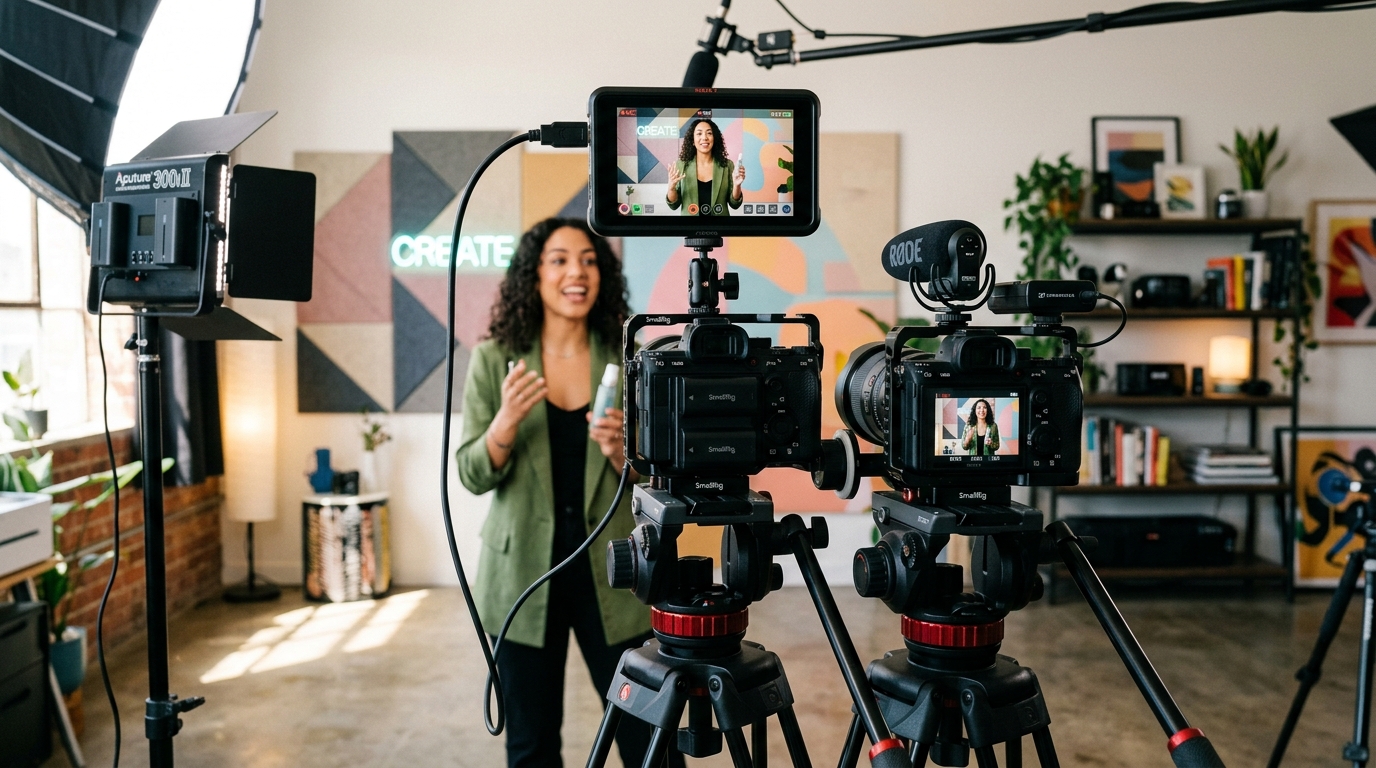
The way to make it sustainable is batching. One shooting day per month producing enough raw material for four weeks of content. It's less disruptive to your actual business, cheaper to produce, and results in visually consistent output rather than whatever you happened to photograph on your phone that morning.
A typical batch day for a small business: three to four hours on location, and you come away with 20–30 usable photos, four to six short videos, and enough B-roll to cut around for a month.
What makes content look professional
You don't need cinema equipment. You need a few things done consistently.
Light. The biggest difference between amateur and professional content, by a distance. Natural light near a window, or shoot in the hour after sunrise or before sunset. Overhead fluorescent lighting flatters nobody.
Steady framing. A cheap tripod costs less than one boosted post and improves everything you shoot.
Sound, for video. People forgive imperfect visuals. They stop watching bad audio within seconds. A basic lapel mic is one of the highest-return purchases in content production.
Visual consistency. The same handful of colours, the same one or two fonts, the same editing style. Consistency is what makes a grid look like a brand instead of a folder.
Captions on everything. Most social video is watched with sound off. No captions means no message.
Formats worth your time in 2026
Short vertical video still gets the widest reach across Instagram, TikTok, Facebook, and YouTube Shorts. Fifteen to forty-five seconds, hook in the first second and a half.
Carousels work well for educational content. Slide one earns the swipe. Save rates on a good carousel often beat likes, and saves are a strong signal.
Photo posts haven't died, whatever the reach-obsessed will tell you. For products, food, venues, and finished work, a genuinely good photograph still outperforms mediocre video.
Behind-the-scenes and process consistently outperforms polished output for service businesses. People are fascinated by how things are made.
Longer video on YouTube is worth considering if you sell something considered or expensive. YouTube functions as a search engine, which means content there keeps working long after you publish it, unlike a post that dies in 48 hours.
When to pay, and how much
Organic reach on most platforms is a fraction of your follower count. Some paid support is now part of the cost of doing business. (Learn how to evaluate agencies with our Agency Selection Guide).
The approach that wastes the least money: post organically first, watch which posts perform, then put budget behind the winners. You're paying to amplify something already proven rather than gambling on a guess.
Realistic starting budgets in Sri Lanka:
| Goal | Monthly ad spend (LKR) | What to expect |
|---|---|---|
| Boosting proven posts | 15,000 – 40,000 | Extra reach, some enquiries |
| Local lead generation | 50,000 – 150,000 | Steady enquiry flow if the offer's right |
| Ecommerce sales | 100,000 – 400,000+ | Enough data to optimise properly |
Below about LKR 15,000 a month, the platform's algorithm doesn't get enough data to learn who to show your ads to. The money isn't wasted exactly, but it works much harder above that threshold.
Meta ads versus Google ads, briefly: Meta finds people who weren't looking for you and creates demand. Google captures people already searching. If nobody knows they need your product, start with Meta. If they're actively searching for it, Google usually returns faster.
Measure the right four things
Ignore most of the dashboard. Watch these:
- Saves and shares: the honest engagement metrics. A save means "this is useful to me later." A share means "I'll put my own reputation behind this."
- Profile visits: people checking you out properly. A leading indicator of interest.
- Link clicks or DM enquiries: actual intent.
- Enquiries that mention social: ask every new customer where they found you. It's the least sophisticated tracking method available and often the most accurate.
Follower count is the metric everyone reports and almost nobody should optimise for. A local service business with 800 engaged local followers will out-earn one with 20,000 scattered across the world.
Doing it yourself vs hiring help
Do it yourself if you or someone on your team enjoys it, has three to five hours a week, and can be consistent. Owner-created content often outperforms agency content on authenticity; nobody knows your business like you do.
Get help if you've tried and stopped twice, you need production quality your phone can't deliver, or you're running paid campaigns where mistakes cost real money.
The hybrid that works best: you supply the raw material and the ideas, an agency handles shooting, editing, scheduling, and ads. You keep the authenticity, they handle the consistency. In Sri Lanka this typically runs LKR 40,000–200,000 per month depending on volume and production level.
Frequently asked questions
How often should a small business post on social media?
Three to five times a week on your main platform, sustained. Consistency matters more than frequency: a steady three posts weekly for a year beats daily posting that stops after a month.
Which platform should a Sri Lankan business focus on?
Facebook still has the widest reach across Sri Lanka, particularly outside Colombo and among audiences over 30. Instagram works well for food, fashion, travel, beauty, and events. TikTok has strong reach with younger audiences. LinkedIn matters for B2B and professional services. Pick one or two and do them properly.
How long before social media brings results?
Organic content typically takes three to six months to build meaningful momentum. Paid ads can generate enquiries within days, but need two to four weeks to optimise properly.
Do hashtags still work?
Their impact has fallen considerably. Three to five relevant, specific hashtags help with categorisation. Thirty generic ones do nothing except look dated.
Should I buy followers?
No. Purchased followers don't engage, which tells the algorithm your content is uninteresting and reduces how many real people see it. It actively makes things worse.
How much does professional content creation cost in Sri Lanka?
A half-day photo and video shoot typically runs LKR 35,000–120,000 depending on crew, equipment, and location. Monthly management with content creation included is generally LKR 40,000–200,000.
Let's make content that earns its place
We're Engage Studio, a digital agency in Kandy. We shoot, edit, plan, and run social content and paid campaigns for businesses across Sri Lanka and overseas. We'd rather bring you twelve enquiries than twelve thousand impressions.
Get in touch and tell us what you're trying to sell.